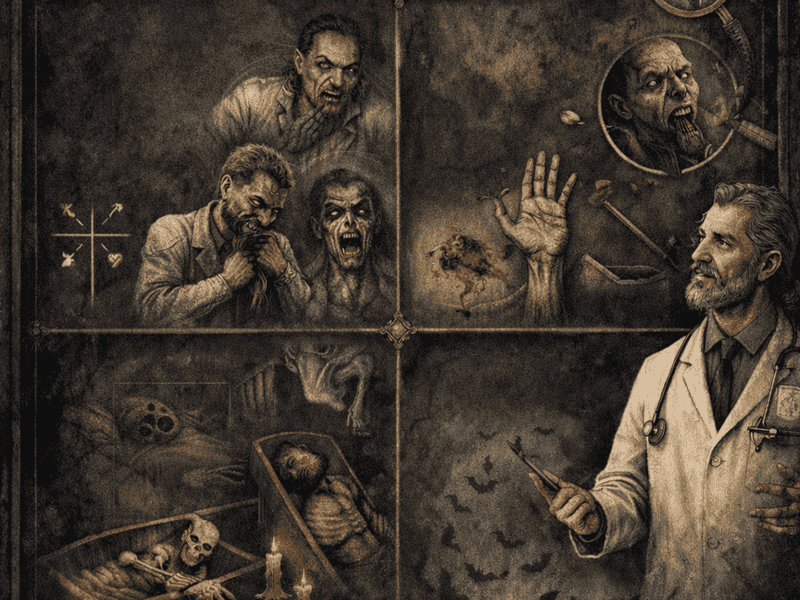
Why medical explanations of the vampire myth are important
Throughout history, people have tried to explain unknown phenomena through myths. The vampire, considered a nocturnal creature with supernatural powers, has its origins in real fears, observed and misinterpreted in the past. Modern medical explanations offer a logical perspective on the symptoms and behaviors that led to the development of the Dracula myth and the beliefs about strigoi and moroi in Romanian folklore.
What rare diseases inspired vampire traits
Some neurological and hematological conditions could in the past be interpreted as evidence of vampirism. People without proper medical knowledge saw bizarre symptoms and considered them supernatural.
- Porphyria – causes extreme sensitivity to light, skin changes, and sometimes dark teeth.
- Rabies (hydrophobia) – triggers aggression, hypersensitivity, facial spasms, and uncontrolled biting.
- Catalepsy – a person may appear dead, only to later "come back to life."
- Severe anemia – paleness, weakness, and an instinctive need to eat foods rich in iron.
How symptoms were interpreted in medieval times
The lack of medical knowledge led to many misinterpretations. In medieval villages, any unusual behavior could be labeled as a "possession," a "curse," or a "sign of unclean death."
- People with high fevers were considered "thrown between the worlds."
- Those who delirious at night were suspected of walking in the form of undead.
- Frequent fainting was associated with "lack of soul."
- Small oral hemorrhages were interpreted as "a sign of blood feeding."
What happens to a body after death and how it influenced myths
Many vampires "discovered" in cemeteries were victims of a limited understanding of the decomposition process. Certain natural transformations of the body were perceived as evidence that the dead were still "living."
- Internal gases that make the body appear bloated, as if it has been breathing.
- Blood left on the lips due to decomposition, interpreted as a "sign of feeding."
- Movement of hair or nails, actually caused by the skin retracting.
- Sounds made by abdominal gases, mistaken for groans or movements of the dead.
What psychology explains about the fear of vampires
Fear of vampires reflects collective anxieties about death, disease, the unknown, and loss of control. In psychology, the vampire is a symbol of negative energies, invasion of privacy, and emotional dependency. That is why the myth persists, even in an age dominated by science.
Conclusion
Medical explanations don't destroy the vampire myth, they make it all the more fascinating. They show how biological reality, fear, the unknown, and incomplete observations have created one of humanity's most powerful legends. Beyond mystery, the vampire is a mirror of the limits of human knowledge in the past and an example of how science and folklore can intertwine in an eternal story.